Saturday, August 18, 2012

Drought 2012 and other challenges

We have had a lot of people asking us how the drought has affected us this year.  Well it hasn't been good, but I can say it's been somewhat better than some of the pictures I have been seeing from farther out in the Midwest.  We have had three rainfalls since early June.  1.6 inches on July 3rd, 0.4 inches on July 19th and 1.5 inches on August 10th.  It's pretty bad when you can remember when it rained and how much it rained for the last 2+ months.  The July 3rd rain really saved the day for a lot our plants that were newly transplanted in the ground.  However, the plants that got transplanted after July 3rd only had that little bit of rain on July 19th so they are pretty stunted.  In fact walking back through a good bit of the vegetable plants gives the feeling that I am walking through the land of the Lilliputians.  Mike was not thrilled when I said I was going to be posting some of these pictures but I told him that this is the year of the drought and people should see what challenges farmers face in dry years.  Now some of the vegetables are doing halfway decent and I'll save those for future blogs, but here is a tour of how the drought has affected our vegetable farm.

These celery root plants were planted about a week or two after the July 3rd rain, so they have been in the ground for over a month.  They are still smaller than my cell phone.


The broccoli plants themselves are not too bad size-wise, but they are either not forming a discreet head, more like a cluster of little shoots like in this plant


Or if they are forming a head, the broccoli heads are very small.


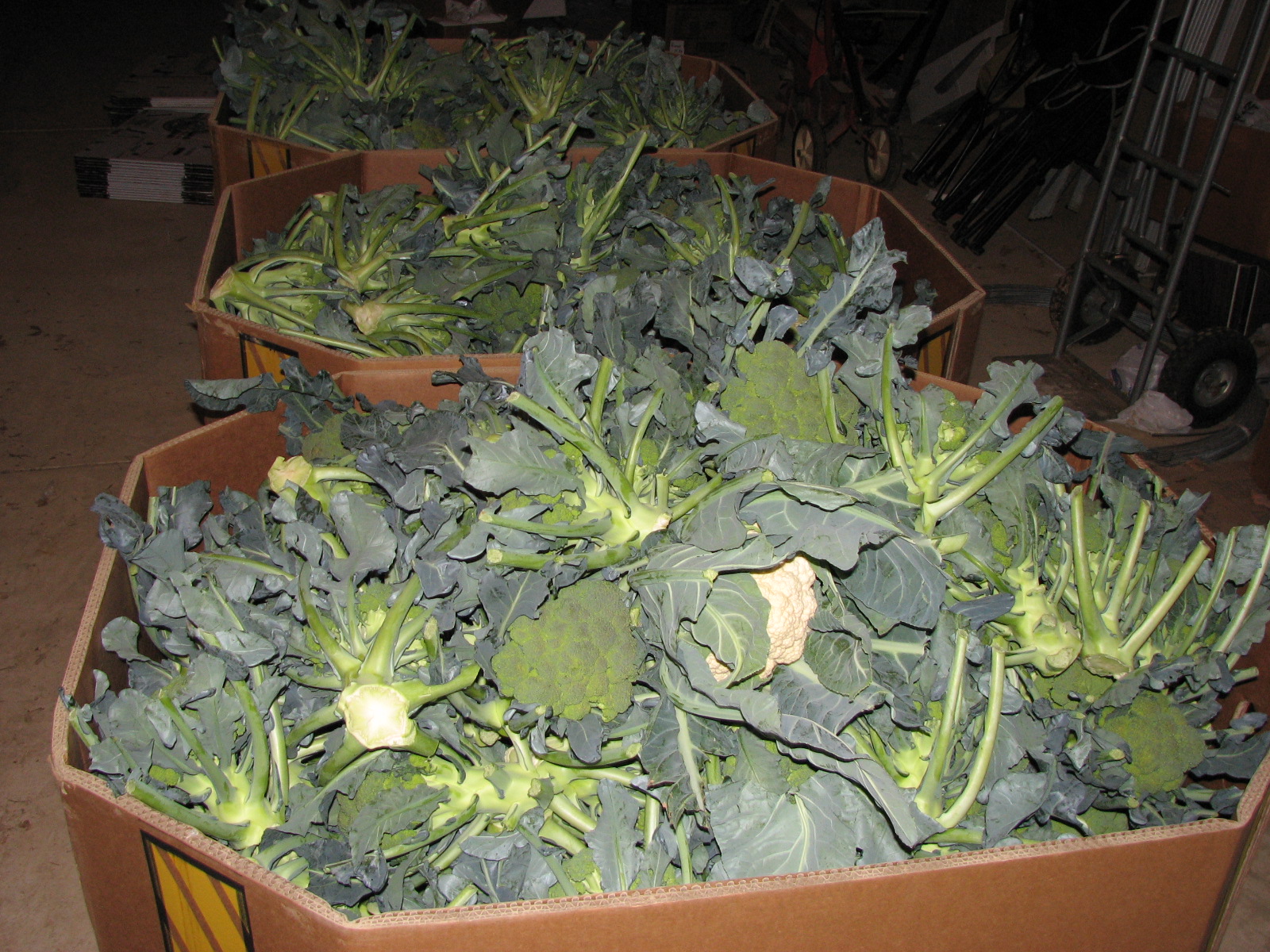
I couldn't find any good comparison pictures of an individual broccoli head from past years, but here is a picture of some large bins of broccoli that we sold in 2010 (These bins are the size of the big bins that you often see watermelons stored in at the grocery store).  A big difference in size to be sure.


Then here are some green beans that are out in the field right now.  The plants are not much bigger than this water bottle and they are starting to flower and will be forming pods soon.


Then there are two different patches of sweet corn that were planted at approximately the same time.  The first patch should be taller than this, but it is growing in the wettest corner of the field and actually produced pretty well for us.  This is the corn that my mom, my sister and I put up in the freezer last week to enjoy all winter long.


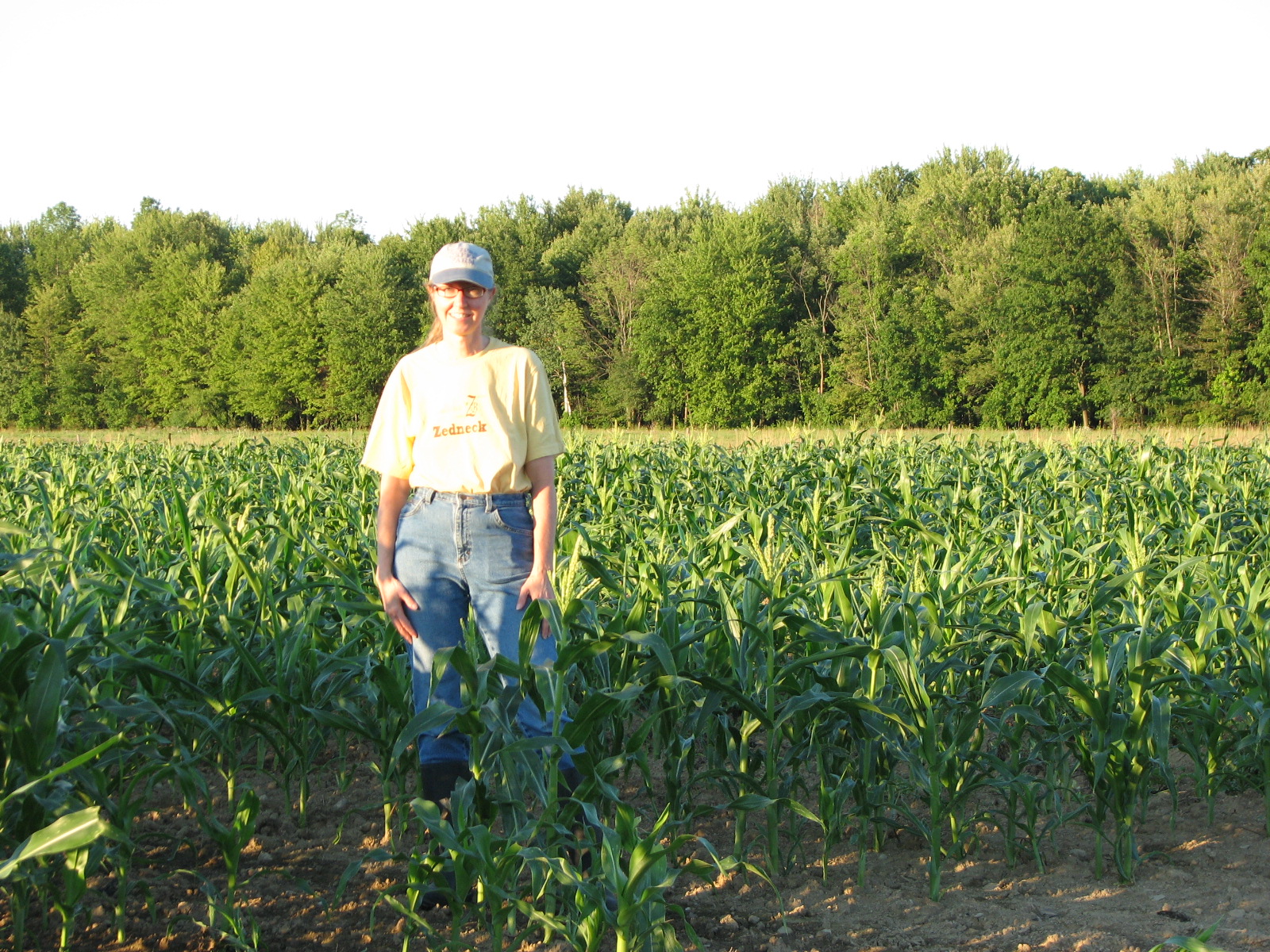
And there this is the patch that is planted in a drier area of the field.  This sweet corn variety normally produces plants that are about 7 feet tall but they are tasseling and are not even waist high.  I have no idea why I am smiling in this picture because I really really REALLY love this variety of sweet corn and it is sad to see it like this.


Mike has replanted some of the cold tolerant plants such as carrots, spinach and beets and is hoping for a late frost.  Those seeds are just starting to come up.  All of the earlier plantings died in the ground due to lack of rain.


And since the blog is entitled "Drought 2012 and Other Challenges", I thought I would show a few pictures of how wildlife can impact crops.  We actually have not had too many problems with raccoons in the sweet corn until just this past week.  Perhaps it was because we wiped out the family that decimated the early blueberry crop and it took awhile for new ones to find their way over here.  Who knows, but they are here now.  We are tolerating the damage right now, but will have to start setting traps again if the problem escalates.


And then last but not least is a look at the soybeans planted this year.  The bushel per acre yield will be lower than average but so much better than what has been happening in the hardest hit drought area of the Midwest.  Overall the plants do not look too bad.


But you don't have to look far to find areas of the field that sit next to a groundhog den.  Pretty impressive groundhog damage shows why farmers hate groundhogs.  From standing in waist high beans in the previous photo to standing in beans that aren't even knee high.


I asked Mike if he thought last year's disastrous year when we had over 2 feet more rain than normal was better or worse than this year and he said it was too early to tell.  It really depends on what happens with all the late plantings of vegetables.

Monday, August 6, 2012

The Yard Aquarium

My husband likes to refer to our chickens as "the yard aquarium".  I think that is a very fitting description.  The laying hens especially provide as with ample entertainment as they get to free range in the yard most afternoons as long as the snow is not piled chicken-deep on the grass.  Our amusement comes from two sources.  One is that they are chickens and we are people.  So often we are left wondering exactly why they do what they do.  The second is that because they are chickens, they have tiny little brains.  They have a hard time finding solutions for obstacles in their lives.  So this blog is a collection of minor happenings in the lives of the chickens on our farm.  It is the reason we have a yard aquarium.

Meet Lucy.  She is one of our laying hens that work for a living.  As such, until about a week ago, she did not have a name.  Names are generally reserved for those lucky few hens that get elevated to pet status, but sometimes a working chicken does something special to distance herself from the crowd.  About a week and a half ago for no apparent reason, Lucy decided that she did not want to go back into the barn to roost at night with the other hens.  She's a skittish little thing and I don't know if you have ever tried to herd a chicken across the yard, but it is very difficult.  And so it came to pass that I just decided to let her do her thing.  It took a few days, but I finally found where she was staying at night which was tucked in behind some old railroad ties that are stacked behind the chicken coop.  Every evening I would tell her she really should go to the barn because she was in danger of being eaten by a variety of predators that wander through the night, but being a chicken she could not grasp the concept of something she could not see right then and there.  Well that and she doesn't understand English.  Every morning I would start my morning routine by walking to the chicken coop saying "here loose chicken, here loose chicken".  She would come out of her hiding spot and I would feed her some vegetable scraps or a little cracked corn.  It didn't take long for "loose chicken" to become "Lucy".  And that is how a working chicken manages to snag herself a name.  This behavior lasted about a week.  Then 4 nights ago Lucy went back into the pen with the others to roost.  3 nights ago, she stayed outside by the railroad ties all night and now the last 2 nights in a row, she has gone to roost with the others in the barn.  Crazy little chickens.

Leaning up against one of the barns is a collection of old pipe gates that are not being used right now.  A few weeks ago I was walking out to the barn to lock up the chickens for the night.  It was just starting to get dark and as I passed the front corner of the barn where the pipe gates are standing, I heard a long pitiful "bawwwwwk".  I looked over and there was a chicken wedged between two of the pipe gates.  Probably in the quest for finding the best bug or worm ever, the hen had walked in between the gates until she could go no further.  And because she is a chicken with a tiny little brain, she could only think of one solution to her problem and that was to go forward.  And in her attempt to go forward, she found herself trapped with her wings awkwardly wrapped around the rungs of the gait.  All it took from me was to gently push her backwards about two chicken sized steps and she was free.  She must have been there for some time though because the first thing she did after she was set free was to run to the waterer and drink for several minutes.  Tiny brains.

One of the other big jobs I finally got done last month was the summertime stripping of the laying hen pen.  With the hens being outside most of the time and the hot weather we have had this summer, I put it off longer than I should have but I finally got it done.  I always wait until late afternoon to do this chore.  By that time the chickens are done laying for the day and they are out in the yard foraging.  It really messes with their tiny little chicken minds to be in the barn while I am shoveling, scraping, sweeping and using the shop vac.  But the confusion for them does not end when the pen is clean and the brand new wood shavings are spread across the pen floor and all is quiet.  Wood shavings that are months old and mixed with chicken manure and dander take on a very drab gray-brown color.  Brand new wood shavings are bright in color with almost a pinkish hue.  Mix together a sudden change in floor color with a very stupid animal that can see in living color and it becomes rather amusing.  The nighttime going to roost isn't too bad as colors are subdued in the fading light.  However morning is a different story.  When I walked into the barn the morning after I cleaned the pen, almost all the hens were still on the roost even though it had been light for a good hour.  You should have heard are the squawking and carrying on they were doing.  The color change was too much for them to comprehend.  They acted like they new shavings were hot coals.  If one of them happened to teeter off the roost and land on the new shavings, it would set of a commotion of wing flapping to get back on the roost as quick as possible.  Every time I do a major clean out of the pen it is the same.  Fortunately it only takes a few hours and the girls do figure out that the new shavings are not dangerous.  It can be tough being a prey species thinking everything is out to eat you.  Tiny little brains.

The new layer chicks are five weeks old today.  Last week I finally started introducing them to food items other than the chick feed they have been eating.  First up, zucchini.  This is always a favored treat among the hens.  The chicks on the other hand have only ever seen feeders filled with crumbled feed so squash is a foreign object to them.  At first as usual, the sight of squash sent terror into their minds and they all huddled in the back of the pen.  One brave Americauna chick did finally come to "look" at the dreaded zucchini before retreating to the back with the others.  I never did see any of the chicks peck at the squash while I was in the barn, but by morning it had disappeared so they figured it out.  Since then they have enjoyed watermelon, tomatoes, spinach and apples.  Each new food item is getting less scary.  

It won't be long until I toss some scraps into the pen and a feeding frenzy will ensue like it does when I toss treats to the hens.

And so the yard aquarium continues to make me smile.  I get such a kick out of looking out the back window to see chickens hanging out on the back deck.  Even chicken droppings on the front porch make me smile.  The chickens act happy and they make me happy.  And although I don't have the room or the time to have a larger flock, it's nice to know that my chickens are feeding a few families with their eggs.  For that I am thankful.

Wednesday, July 11, 2012

The year of the varmint

The most significant event that has happened since the last time I blogged was that it rained.  That event was most significant indeed.  Just like a good chunk of the Midwest, we have been lacking moisture in the form of either rain or snow since the beginning of the year.  We had some planting delays this year but most of it was more of a personal matter than a weather related matter.  With the warm dry spring, most farmers around us were well ahead of their normal planting schedule.  But a couple weeks ago, Mike and the crew were going full tilt getting the flats of vegetables planted.  And then things started looking desperate back in the fields.  The unplanted flats of vegetables by the barn were getting watered daily.  The newly planted vegetable plants in the field were withering from the heat and lack of rain.  The soil was getting drier and drier and we have no water source for irrigation.  The house water well was on the verge of giving out as well.  We were in severe water conservation mode.  The animals got first priority and the unplanted flats of vegetables got second.  I even took a trip to the laundromat instead of doing laundry at home and I was showering at work.  And then one week and a day ago it rained.  Blessed rain.  It rained slow and it rained all day.  At the end of 24 hours, we had 1.6 inches of rain.  Without it, those newly transplanted plants would have surely died.  In the nick of time is an understatement.


With disaster at least temporarily averted, the last week has been spent tending to other threats to the crops namely varmints.  My evolution into a varmint hunter has been an interesting journey but the scale of the damage these critters have caused this year is reaching epic proportions.  Sometimes necessity takes over.


There are all sorts of reasons why I should not be out in the fields with a gun chasing after small furry critters.  I grew up in a middle class suburb and was schooled in the ways of Bambi and Lassie.  I developed a strong love of animals and loved every encounter with every raccoon and squirrel and snake or whatever I would come across in my romps in the woods behind the house.  Then I harnessed that love of animals and became a veterinarian with years of training to keep animals alive and healthy.  But life is full of twists and turns and the desire for a rural lifestyle and marrying a farm boy brought me to living on this farm.   Along the way I came to embrace the thought that man is just as much as part of the natural world as any other living thing.  We must be careful to not take too much, but taking some from nature is, well, natural.


That brings us to varmints.  When I first started to hunt, I said I would never kill an animal that I didn't intend to eat.  However, all it took was a raccoon trying to break in and kill my chickens to change my views.  Mike grew up on a farm so shooting varmints that damaged crops is second nature to him.  It's not that he likes doing it, but it is necessary if to protect crops and make a living.  And now I have been absorbed into the farm lifestyle.  We enjoy wildlife watching immensely, but the line is drawn when they start causing damage.  Raccoons in the woods are fun to watch.  Raccoons in the chicken barn are unacceptable.  And as Mike and I learned late last week, raccoons in the blueberry patch are unacceptable too.  


The only critters that we have had to keep out of the blueberries are the birds and that has been easily accomplished with bird netting over the bushes.  That is until last week.  On July 4th I took a stroll past our early variety of blueberries to check progress.  Most of the berries were ripening and all was looking good for our first picking to go to Saturday's farmer's market.  On Friday evening, I was unloading bags of chicken feed and Mike walked back to the blueberries.  As I finished my job and pulled my car around into the driveway, I heard Mike screaming.  I looked back to see him standing by the berries.  I heard "bring a gun" and "raccoon".   I ran and got a gun and some ammo and hopped into my car and drove back to the blueberries.  Mike said when he got back there, a young raccoon had run out from under the bird netting but another young one was sitting still in the middle of one of the blueberry bushes.  Mike shot that one and then we set a trap for the other one which we ultimately caught and killed the following day.  The damage?  In the three days since I had last checked the blueberries, those raccoons had stripped all the early bushes of every bit of ripe fruit.  It was a total loss.  We have later varieties of blueberries that will mature in a few more weeks and we did what needed to be done to protect them.


That brings me to the garden.  Mike and the crew have planted broccoli in the rows that run along the fenceline with the neighbor's.  The neighbor's field on the opposite side of the fence from us is a hayfield.  We know there have always been some groundhogs living along the fenceline and for the most part, since they have not caused too much damage, we have left them alone.  However, with the super dry conditions, the hayfield has turned brown after it was cut for hay.  The groundhogs have been looking for better food and have found the broccoli.  The rabbits may be helping a little bit, but I have seen a groundhog carrying nearly an entire broccoli plant in its mouth and seeing is believing.  The groundhogs must go.


This is a picture of a row of cauliflower about 4 or 5 rows from the fenceline.


And here is a row of broccoli 2 rows closer to the fenceline.


And because of this I hunt the broccoli eating varmints.


I have not quite come to full terms with eating a groundhog however.  Oh, I have heard it tell they are quite tasty and they probably are.  But on the farm, there are others that need to feed their children and so I am more than happy to help them with a few handouts.  Nothing in nature ever goes to waste.


Friday, June 29, 2012

Small town moment #393

There are certainly smaller towns out there and it's not like Ohio is in the middle of nowhere, but I live in a small town.  Last census, I think our township finally went over 1000 people by a little bit.  There are no stop lights.  The center of town is a crossroads of two state routes with the tiniest of convenience stores on one corner, the township hall on another and two farms on the other two corners.  We don't have our own post office but instead our township is divvied up among the neighboring postal routes.  It is 15 miles one way to the nearest WalMart.  The closest grocery store is a little over 6 miles away.  Not too bad actually, but much different than the large suburban community I grew up in.  I love living in a small town.  It's very rare indeed that I miss the lights and noise of the city.


Since we moved out here, Mike and I have had lots of small town moments and today was a perfect example.  Mike and some of our Amish employees had been working on transplanting plants all morning.  Around noon they happened to be back near the barns loading up more plants when our mailman Kenny pulled into the driveway.  Usually the only time he does that is when we have a package that we have to sign for.  When Mike walked up to the vehicle, Kenny handed Mike three six packs of started tomato plants.  Seems as though Kenny was delivering the mail on the next road over.  On that road about 4 miles from our farm is where our neighbor with the greenhouse lives and she is the one that starts the majority of our vegetable plants.  (Is it still considered a "neighbor" when they live 4 miles away?  Yes, out here it is.)  Well, Kenny saw these tomato plants sitting on the side of the road.  He got out to take a look and there was a tag on them that said "Mike".  He said he couldn't think of anyone else whose plants they could be and so he picked them up and brought them over to our farm which happened to be on the continuation of his route.  Yep they were our plants that had fallen off the wagon yesterday when Mike had been hauling some more of our plants from the neighbor's greenhouses to our farm.  And so we now have had tomato plants delivered to us via the postal carrier.  They looked just a little bit haggard from their rough trip to the farm, but not too bad considering.


Mike and his 2 person crew planted just under 5000 plants this morning.  I'll try to get some pictures of the progress put up in the next 2 or 3 days.