Sunday, June 15, 2014

Goodbye barn. Hello grass.

Yesterday was moving day for the meat chicks, but I thought I'd take just a moment to catch up on the 2014 farming season so far.

It's been quite the spring farming season.  The weather, as usual in farming, has dominated what has been happening, or rather the lack of what has been happening.  In a repeat of last year, the skies have rained and rained.  We have had standing water in the fields since June of last year.  In a so called "normal" year, we would be starting field work in late April or early May.  A short recap of this spring's activity goes like this:

May 27th was the first day it was dry enough for a plow to touch the ground.
May 30th tomatoes went into the high tunnel.
June 1st the first sweet corn, peas, green and lima beans were planted.
June 3rd onions planted.
June 4th the soybeans got planted.
June 8th we had an all day rain that totaled just a little more than an inch. 

That little event on June 8th brought everything to a screeching halt.  June 11th would have been dry enough to do some light field work and then it rained.  June 12th we had a little more rain.  June 13th was deemed dry enough to start tilling.  Mike and the girls were just ready to start laying plastic and then it rained.  The ground will now need tilled again before any plastic can get laid.

Back to the chickens.  Their move to pasture was delayed as well.  The target date to move them was June 8th, but that was the day it rained over an inch.  The entire next week the weather service was predicting the possibility of thunderstorms and I certainly did not want to introduce them to the outside world and then have them sit through a storm their first night out.  And so I waited.  And waited.  But yesterday was the day.  Almost always I will have the pasture pens ready to go and just have to get up in the morning and move the chicks.  But all last week it rained or the wind would blow or both and so yesterday I had to prepare the pens, move the chicks and the feeders and waterers.  Along the way, I took some pictures.

The pasture pens are based on Robert Plamondon's hoop house.  You can find more information about them on his web site:  CLICK HERE.  They are floorless pens that are 8 feet X 9 feet in dimension.  This allows the chicks to have access to the grass.  In the winter, they sit out in the grass all naked so yesterday's first job was to get them dressed.


"Dressing" involves several tarps and lots of bungee cords.  I always seem to be tarping up the pens by myself which is why I had to wait for a day with light winds.  I've done it before in the wind.  It doesn't work well and when doing this job by myself in the wind, the words "flying solo" come to mind.


Next job to move the chicks.  This part is good exercise.  My brooder pen is about 12 feet by 12 feet.  I built it in the bottom of our bank barn with scrap wood that had been left behind by the farm's previous owners.  One wall is plywood.  One wall is pressed fiberboard.  One wall is T-111.  You get the picture.  For some reason that escapes me now, I built a 4 foot high and 4 foot wide ledge that runs the back of the pen.  It creates a space for the chicks to try and hide from any human trying to catch them and makes the human chasing them have to crouch down and waddle like a chicken.  Humans are not meant to crouch down and waddle like chickens.  Thus, this part is good exercise.  After numerous leg squats, all chicks were rounded up and transported out to the pasture pens and divvied up between the pens.


Next I had to go get the feeders and waterers.  Even though they are on grass where they get to eat plants and bugs, they still need some chicken food.  These are fast growing eating machines.  Plus it takes them a little bit to figure out grass and bugs are food.


And a final view of the pens with my little red tractor with my little red wagon that I use to haul feed and water out to the chicks.  We'll be butchering them in 4 weeks.  Fast growing little buggers.


Sunday, April 6, 2014

Ice out and other signs of spring

The farm pond is officially one year old and last weekend was its first official ice out.  It happened fast too.  On March 23rd, the pond was frozen solid.  I'm sure I could have easily walked across it.


7 days later after a couple days in the 50's and 60's and some rain, I wandered back to the pond and except for a small raft of floating ice that the wind had blown to the far southeast side, the pond was free of ice.


It was a chilly but sunny day and the dogs and I took a nice 3 hour walk around the farm.  Peters Creek was wide and spilling over the bank that day.  A pair of mallards has been visiting the creek daily and if you look carefully at the picture below, you can see them just on the horizon as they took flight off the creek as I walked by.


Even though the ice is off the pond, the ground is still quite frozen.  When it warms up during the day, there is a thick layer of squishy slick mud on top, but underneath the goo on top, the ground is still quite firm.  So it will be some time yet before plow meets earth around here.

Last weekend also brought about a long overdue project.  Last fall, I started a new batch of laying hens.  They came to the farm as day old chicks during the first week of October.  I set them up in the 8'X12' brooder pen where I start my meat chicks in the summer.  Starting the pullets in the brooder pen meant I could let my older layers and roosters have full run between both pens in the layer barn.  This gave the older chickens more room during the snowy months when they don't have a chance to go outside in 2 feet of snow.  Most winters we will see some sort of brief January thaw and I figured that would be a good time to divide the two pens in the layer barn and move the young pullets over just before they started to lay their eggs.  Well this winter wasn't like most winters.  We never had a thaw and the weather stayed cold and snowy.  It was too frozen to try and strip pens and get the pullets moved over.  And so the pullets stayed in the brooder pen.  I moved a bank of nest boxes over when they were ready to lay eggs.  The brooder pen does have fold down roosts for them, but they are less then adequate for long term use.  Then as the snow started to melt I started having issues with water coming in the brooder pen.  Issues that I never have had in the summer with the meat chicks.  That was a pen management nightmare, but I was able to keep on top of things for the most part.  FINALLY last weekend I was able to strip out the pen in the layer barn and move the pullets to their new abode.  Their tiny little chicken brains were totally freaked out by the move, but after one week, I think they are finally adjusting.  Another week or so and they will get to start free ranging in the yard with the older birds.


This past week also brought the first groundhog sighting of the year.  OK, it was down the road a bit, but I'm sure a few of the farm residents are out and about too.  Two nights ago, I did evening chores to the sound of spring peepers.  Yesterday, a walk back in the field found the garlic shoots starting to emerge.  Spring is progressing step by step.

Sunday, March 23, 2014

Supposedly spring

You know it's spring when ......  your local farmer who has been hibernating all winter thinks about starting up this year's blog.

You know it's spring and it's still cold when ..... your local farmer has time to sit down and write in the farm blog.

Spring equinox arrived last week.  Although there have been a few "warm" days thrown into the mix, spring so far has been what can only be described as a continuation of one helluva a winter.  The weather service tells us we aren't even close being the coldest winter on record, however it certainly has been the coldest in recent memory.  The number of sub zero degree readings and the weeks of sub-normal temperatures have been amazing.  January temps were 6 degrees below average for the month.  February temps were 6 degrees below average for the month.  March is a little over 5 degrees below normal for the month so far.  And on it goes.  We are hopeful that all this cold weather killed a lot of bugs that feed on vegetables.  Thinking positive here.

Needless to say, outdoor work that normally takes place in March is not getting done.  So sorry, but I am not going out and pruning the blueberry bushes when it is 20 degrees out with single digit windchills like it has been today. (Normal high is 49 degrees).  Just ain't happening.

Indoor work is going on.  Seeds have been ordered and the UPS truck is making regular stops at the farm.  Some of our seeds have been started in greenhouses.  Hints that someday it will be warm or at least that's the rumor.

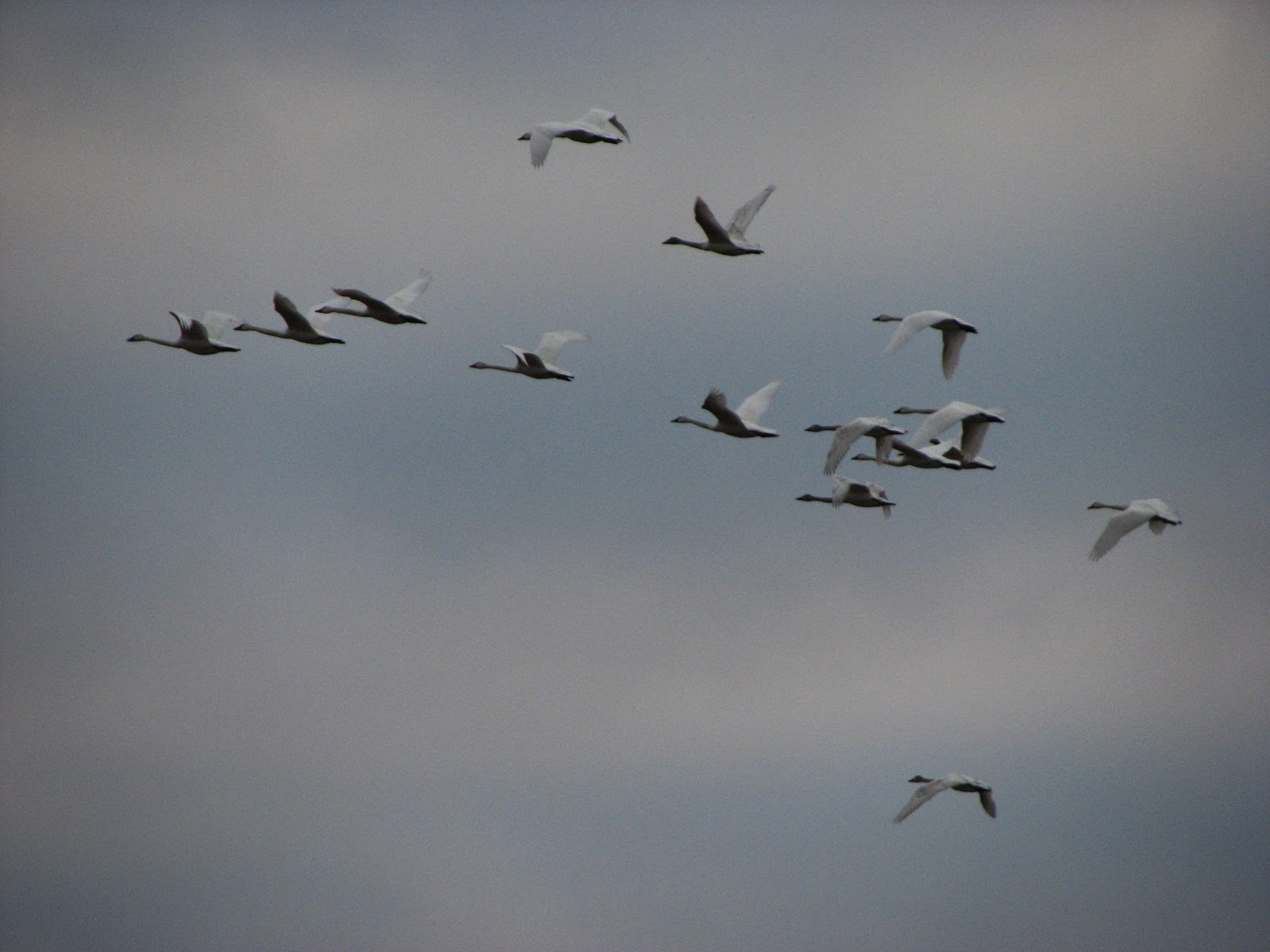
And in spite of the cold, spring is here.  You have to look no farther than the birds.  They have no choice.  Nature dictates that for the most part, their behavior changes as the length of daylight gets longer and longer.  Three weeks ago the redwing blackbirds arrived.  Two weeks ago a few turkey vultures and a few robins showed up at the farm.  Last weekend, we were blessed by the tundra swans migrating through and making a brief rest stop on the farm.  In years with more open water, they sometimes say longer, but this year I heard them for three days in a row and then they were gone.  I was able to get a few pictures of them at the far end of one of our picked corn fields.


And on Friday, the day after the spring equinox, I stepped out of the house in the morning and was greeted by the song of a woodcock in the pasture.  And Friday evening as we were loading the car up for Saturday's farmers market, a turkey gobbled from the woods across the road.  The birds know spring is here.  Now Mother Nature just has to turn up the thermostat.

The farm pond: March 23, 2014.  Ice, ice Baby.


Monday, December 9, 2013

2013 review in pictures and few words.

As you can see, I haven't done much blogging this year.  For those who wanted to know what was happening on the farm that probably wasn't a good thing.  For those of us living through the disastrous farming year of 2013, it meant less time writing depressing news in the blog.  Heck who wants to read about doom and gloom all summer long anyway.  But I thought I would do a year end wrap up by pulling a few farm pictures from each month of the year.  I was kind of chuckling as I worked my way through the year.  I organize all my pictures by the month they were taken.  The first half of the year I have a good amount of farm pictures, but as the year went on there were fewer and fewer pictures of the actual farm.  You'll see what I mean as I go forth in remembering 2013.

January didn't start off too bad.  We had snow of course.  Duh!  The fields were covered, but alas under all that snow were the cold hearty Brussels sprouts.  It is always a treat to have fresh produce in the middle of winter.  Well it is a treat for those eating them.  Not so much for the farmer picking them.


February we had snow too.  Shocking I know.  This is the time of year that the words "cooped up" have true meaning here on the north coast.  As you can see the chickens are feeling it as they stand at the edge of the barn door looking out into a world of white.  I never did have a chicken that would step outside in more than a dusting of snow.  And I don't take many pictures of the sky on purpose but I came across one of the February full moon.  We don't take clear skies for granted around here as we live in one of the cloudiest locations in the United States.


In March I dug up some carrots that had overwintered in not too bad of shape.  Their tops had all be eaten off by the deer, but the roots made for a tasty meal of cooked carrots.  And surprising as it sounds, we had snow in March too.  The chickens were surely getting sick of being in the barn because I found some tracks from a few adventurous chickens.


April gave us the pond project as part of our irrigation grant.  We sure could have used the pond during the drought of 2012 but by gum, we were going to have a pond for 2013.  The irrigation project became a huge joke later on in the fall as we laid drip line in the mud.  But I am getting ahead of myself.  In April the pond got dug and before the creek dried up like it does every summer, a huge pump was brought in and the pond was filled in about 3 days.


May started off in fine shape.  At one point it was actually getting a bit too dry, but overall things were going well.  Ground was getting plowed and disked, the high tunnel had plastic laid by hand and tomatoes and peppers were planted and rows of plastic were being laid in the field.


In June our farm season fell apart.  We had the beginning of what turned out to be 16 straight days of rainfall.  I thought about writing a blog entitled "It rains 16 days what do you get" to be sung to the tune "16 Tons", but it was just too depressing.  June is our planting season.   The yard flooded.  The fields flooded.  Our namesake Peters Creek that flows in between our house and our field should have been on its way to being a dried up trickle of water, but as you can see, it became more like a lake.  In between rain drops, we tried to plant in the mud and we did get some things planted, but because it never dried out the rest of the summer, most of our early planted transplants died.


July I have no pictures of the crops.  That's because there were no crops other than flats of plants that had not been planted or rows of transplanted plants that were rotting in the field.  I do however have a couple pictures that were taken in July.  Our broody hen Mama Buffy was showing her chicks how to forage in the yard and I took a picture of our employee parking lot in the pasture.


August brought the infamous "Tractor Stuck in Mud" picture.  What is striking about the picture is all the green in picture.  Look closely at not only what the green is that is growing, but notice how uniform it is and look for what is missing.  That green in the picture is spike rush which is an aquatic plant that grows in ponds.  Yes, we had a field of pond weeds.  As for what is missing, well, there is no pigweed or lamb's quarter or ragweed or smartweed or any one of a variety of weed's that grow up in the field between the rows every summer.  And for the farmers that are reading this, you should know that our fields have been tiled.  If they were not tiled, we would have never had anything planted this summer.  Oh and in my August folder, I also have quite a few pictures of the neighbor's cows across the road.  They presented a much prettier picture than the horror that was behind our house in the fields.


In early September we actually picked some beans.  They weren't plentiful, but they were more plentiful than the early plantings of beans that all drowned and died.  I was able to get a dozen or so quarts canned and we sold a few too.  We also had our first frost on September 17th, but fortunately it was contained to the low lying areas by the creek and did not harm anything back in the fields.


October brought wonderful fall colors.  The late plantings of cold tolerant plants such as broccoli, cauliflower and Brussels sprouts were actually growing.  They did not over-perform, but we got enough off those plants to salvage something from an otherwise disastrous year.  The red maple that sits behind our house lit up the scenery as it does every year.  And we had our first snowfall on October 24th.


My November file has slim pickin's for pictures of the farm.  About all I have is one lonely picture of a head of broccoli that I took in the pitch dark with the flash from my cell phone.  It was nicer to look at the fields in the dark anyway.  We did sell a good bit of broccoli, cauliflower and celery root in November.  Rabbit season also started in November and the dogs and I were able to get a couple of rabbits for the dinner table.


So here we are in December wrapping up 2013.  In spite of all the bad that happened, there were bright spots as well.  We had an awesome group of CSA member's this year.  We thank you all for your patience as we worked our way through the growing season.  As usual we had a great time selling at the Countryside Conservancy farmers market at Howe Meadow in the Cuyahoga Valley National Recreation Area.  Mike is already getting seed catalogs in the mail.  Soon we will be placing orders for the 2014 growing season.  Farmers and Cleveland Browns fans have a lot in common.  We all know there is always next year.